
Executive coaching should help us become better leaders. Better for whom, and toward what?
Effectiveness is not enough. Becoming more productive, more persuasive, or more resilient tells us very little about what those capacities are being used to create.
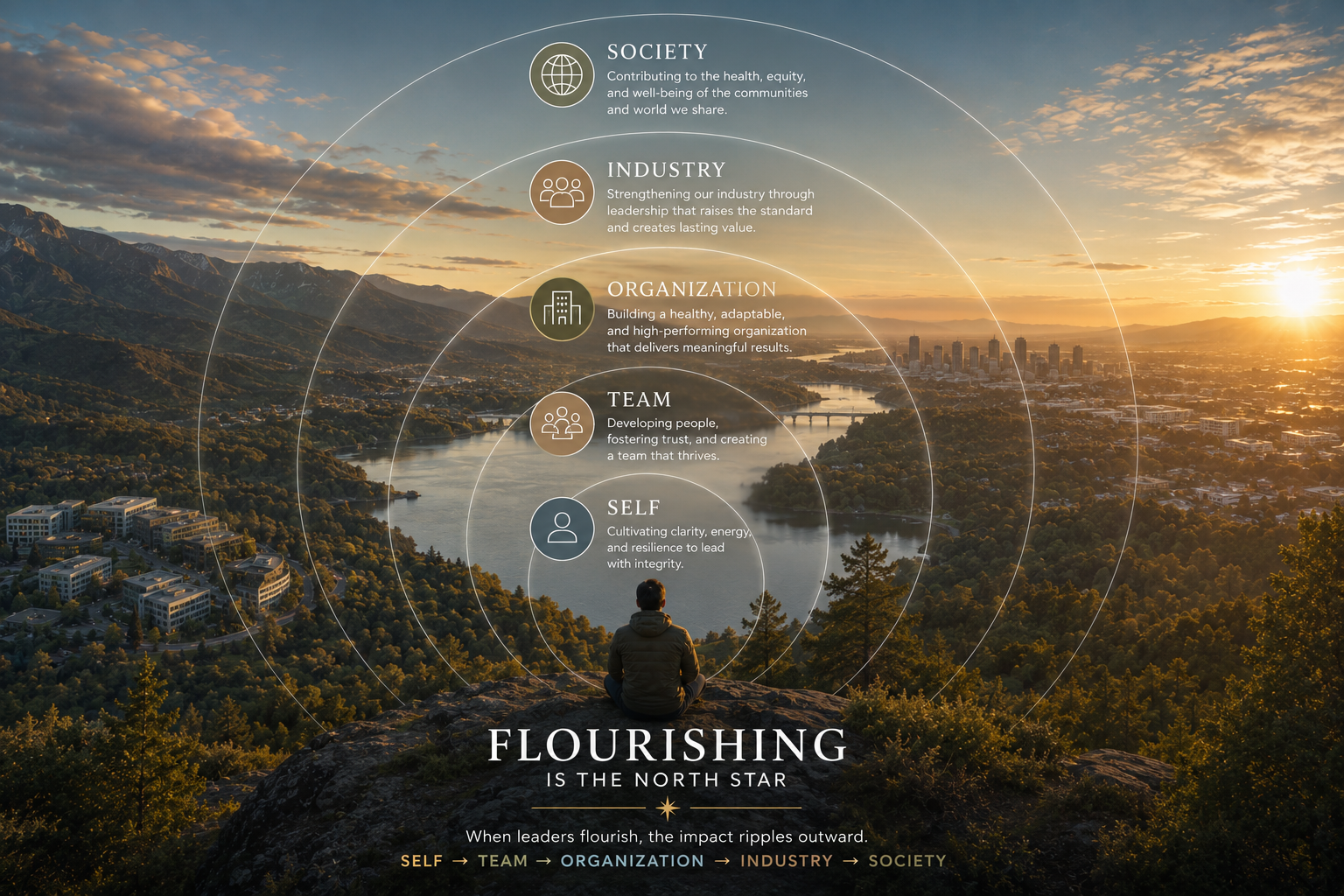
Flourishing is the North Star. Leadership development should contribute to the flourishing of the leader, the people closest to them, the organization they lead, the systems that organization shapes, and the wider world all of it touches.
Change happens through practice. Insight in a coaching session matters only if it changes how you meet the ordinary moments where leadership actually happens.
There is a question missing from most conversations about executive coaching. Not what executive coaching is, which is easy enough to describe, but what executive coaching is for. What is all this development actually meant to produce?
We talk about executive presence, strategic thinking, emotional intelligence, communication, delegation, resilience, decision-making, influence. These are useful capacities. They are not outcomes.
A leader can become more persuasive and use that ability badly. A leader can become highly productive while making everyone around them miserable. A leader can learn to manage stress well enough to tolerate an organization that should change. A CEO can hit every performance target while barely seeing their family. A nonprofit executive can sacrifice their health in service of a mission devoted to improving other people's lives. An organization can grow while its people burn out.
So before asking what executive coaching is, there is a harder question underneath it. What kind of change are we actually trying to create?
For me, the answer is flourishing.
Not flourishing in the superficial sense of feeling good all the time. Flourishing includes difficulty, responsibility, sacrifice, disagreement, and uncertainty. There are moments when good leadership requires doing something deeply uncomfortable. I mean something more demanding than comfort: can this leader become increasingly capable of doing meaningful work, exercising good judgment, building healthy relationships, developing other people, navigating difficulty, acting with integrity, and sustaining a life worth living? Can the people around them flourish too? Can the organization become healthier and more capable because of how they lead? Can the systems that organization touches be better for its presence?
That is a larger ambition than producing a more effective executive. It is also how we think about executive coaching.
Effectiveness is not the same as flourishing
Executive coaching has always been easy to frame around performance. Become a better communicator. Delegate more. Increase influence. Manage conflict. Think more strategically. Improve executive presence. These may all be worthwhile goals, and there is an unanswered question sitting underneath every one of them: in service of what?
Imagine that coaching helps a leader become dramatically more productive, and they accomplish it by sleeping less, working every weekend, and becoming steadily less available to the people they love. Did the coaching work?
Imagine that a CEO becomes more decisive, the organization moves faster, and the people around them gradually stop questioning their judgment. Is that successful leadership development?
Or imagine that a burned-out executive learns enough stress-management technique to keep functioning inside an organizational system that is making people ill. Have we developed the leader, or simply increased their capacity to tolerate something that needs to change?
Effectiveness matters. Results matter. Performance matters. None of them, by themselves, tell us whether leadership is good. We need a larger North Star.
Flourishing moves outward
The consequences of leadership do not stop at the leader. They travel outward through five levels, and each one is a legitimate place to ask whether the development is working.
Self
Leadership begins with a human being, and that human being comes to work too. This is not a wellness footnote to the real subject. It is the ground the rest of it stands on.
Can you carry responsibility without being consumed by it? Can you think clearly under pressure? Can you direct your attention rather than having it captured? Can you recognize what is happening in you before you act from it? Can you sustain your energy, sleep, and the relationships that matter? Can you succeed professionally without gradually constructing a life you do not want to inhabit?
Team
Then the circle widens to the people in immediate proximity to your leadership.
Do people grow around you? Can they disagree with you? Can they tell you something you do not want to hear? Do they have meaningful autonomy? Do you develop their judgment, or make them more dependent on yours? Can they make mistakes without becoming afraid to act? Do they understand what is expected of them, and do they experience dignity in how they are treated?
A leader's development should not only make the leader more capable. It should increase the capacity of the people closest to them.
Organization
Leadership also shapes systems. Repeated decisions become structure, and structure becomes culture. What kind of organization are your decisions helping to create?
Can it make good decisions without everything flowing through one person? Can information travel honestly? Can people disagree productively? Can it learn from mistakes and adapt? Can it retain and develop strong people? Can it perform without relying indefinitely on heroic effort? Does its culture reinforce the values it claims to hold?
The leader and the system continually shape one another. Good coaching should be able to see both.
Institution
No organization stands alone. It belongs to a sector with its own norms, incentives, and inherited habits, and it either reinforces those norms or shifts them. A hospital shapes how care is delivered. A university shapes what counts as knowledge worth producing. A company shapes what its industry treats as an acceptable cost of doing business.
At this level the question becomes whether the organization is serving its actual purpose or its inherited narrative. A business creates value for customers and stakeholders. A hospital cares for patients. A nonprofit advances a mission. A public institution serves citizens. Eventually leadership has to be evaluated in relation to what the organization contributes beyond itself, and whether the way it operates is one that others in its field would be better for copying.
Society
The widest circle is the slowest to move and the hardest to see. What gets repeated across enough organizations stops looking like a choice and starts looking like the way things are.
Whether urgency is a temporary response to extraordinary circumstances or a permanent condition. Whether disagreement is welcomed or punished. Whether people leave work with enough of themselves left for the rest of their lives. These are decisions made by individual leaders, thousands of times a day, until they harden into what a culture takes for granted. What we practice at scale becomes collective habit.

These five levels are not boxes to check. They are interconnected, and the interconnection is where the honest work lives. An organization can prosper financially while exhausting its people. A leader can protect their own wellbeing while avoiding the difficult responsibilities of their role. A team can have warm relationships while failing to accomplish what the organization exists to do. A mission-driven organization can create real external impact through working conditions that no one could sustain.
Flourishing does not mean maximizing one variable. It means learning to see the whole.
What is executive coaching?
With that North Star established, the definition becomes fairly simple.
Executive coaching is a structured developmental relationship that helps a leader see more clearly, choose more intentionally, and practice ways of leading that contribute to flourishing.
That requires more than good conversation. A serious engagement is anchored in questions with real weight behind them. What is happening now? What needs to change, and why does it matter? Who is affected? What might we not yet understand? What patterns are contributing to the current situation? What would you need to practice differently? What evidence would tell us that meaningful change is actually occurring?
Depending on the challenge, the work may draw on assessment, stakeholder feedback, behavioral goals, structured reflection, experimentation, measurement, and accountability. None of those is the purpose of coaching. They are tools. The purpose is development, and development begins by becoming capable of seeing something you could not previously see, then learning to meet it differently.
Turn inward with care
When something is not working, the instinct is to look outward first. What is wrong with my team? Why doesn't this person understand? Why is the board behaving this way? Why won't people take ownership? Why can't the organization move faster?
Sometimes those are exactly the right questions. Leadership also asks us to turn inward. What am I bringing to this situation? What happens in me when this person challenges me? What am I protecting? What do I keep doing even though I know it is not helping? What am I avoiding? What happens in my body when the pressure rises? What am I no longer able to hear? What might other people experience when they encounter me?
Turning inward does not mean assuming everything is your fault. It means becoming willing to include yourself in what you are examining.
Doing that requires care. Without care, self-examination collapses quickly into self-criticism, or defensiveness, or shame, or one more optimization project in which you catalogue everything wrong with yourself and set about fixing it. Care creates a different possibility: curiosity. Can you look honestly at what is happening without immediately needing to condemn, defend, or repair it? That quality of attention is itself a leadership capacity.
See clearly with wisdom
Awareness alone is not enough. We also have to understand what we are seeing.
What is actually happening here? What am I assuming? What belongs to me and what belongs to the system? What is important and what merely feels urgent? What is the difference between the story I am telling and what I actually know? Where is a strength being overused? What consequence am I not considering? What tradeoff am I pretending does not exist? What will this decision create for other people? What happens six months from now if nothing changes?
Wisdom is not having all the answers. It often begins with recognizing that the first answer may be incomplete. It asks for perspective, discernment, and the capacity to hold competing truths without rushing to collapse them into something simpler than they are. As responsibility grows, leaders meet fewer problems with obvious answers and more situations requiring judgment. Seeing clearly is what allows us to choose rather than react.
Engage with courage
Then comes the part no insight can do for us. We have to act.
Have the conversation. Delegate the decision. Say no. Change the strategy. Set the boundary. Ask for help. Admit you were wrong. Tell the truth when ambiguity would be more comfortable. Make a decision people will not like. Stop doing the thing that once made you successful. Or stay with uncertainty long enough to avoid manufacturing false certainty simply because not knowing is uncomfortable.
Courage is not fearlessness. It is the willingness to act with integrity in the presence of difficulty, and leadership eventually requires it.
Care, wisdom, and courage are not steps
The OLEL Method™ is easiest to describe through three movements: turn inward with care, see clearly with wisdom, engage with courage. They are not three stages completed in order. We do not finish caring and move on to wisdom, then graduate to courage.
They are interdependent dimensions of one practice. Care without wisdom becomes avoidance. Wisdom without care becomes cold. Courage without either becomes recklessness. In the OLEL Method™, these three movements organize eight interconnected dimensions of practice, covering how we cultivate energy and attention, understand what is happening, orient intention, communicate, act, and create value through our work. They inform one another continuously. Sometimes courage sends you back toward care. Sometimes closer attention changes what you can see. Sometimes seeing something clearly forces you to reconsider what courageous action even means.
Development is less like climbing a staircase and more like deepening a practice. That distinction changes what coaching is for.
The coaching session is not the practice
You can have an extraordinary insight at three o'clock on Thursday afternoon and behave exactly the same way at nine o'clock Friday morning. Understanding is not transformation. Leadership changes through practice, and the practice happens somewhere other than the coaching session.
You are in a meeting and someone is taking too long to explain something. You feel yourself becoming impatient.
There is the moment.
Normally you interrupt. This time you notice the impulse and keep listening.
Your direct report brings you a problem and you immediately see the solution.
There is the moment.
Normally you give them the answer. This time you ask what they think.
Someone challenges your strategy and your body tightens.
There is the moment.
Normally you start assembling your defense while they are still speaking. This time you get curious.
You are about to have a difficult conversation and you notice yourself rewriting the email for the fifth time rather than walking down the hall.
There is the moment.
You go.
You arrive home after a hard day and reach for your phone at dinner.
That is a moment too.
You put it down.
None of these actions is dramatic, which is the point. The coaching conversation may help you see the pattern. Ordinary life is where you practice something different, and those ordinary moments repeat. Meeting after meeting. Conversation after conversation. Decision after decision. Eventually what you repeatedly practice becomes how you lead.

What, then, does a coach actually do?
A coach helps create the conditions in which you can see what is difficult to see from inside your own life. Sometimes that happens through a question. Sometimes through assessment or stakeholder feedback. Sometimes because someone notices a contradiction in what you just said, or because the same pattern has now appeared in four apparently unrelated situations. Sometimes through measurement. Sometimes through silence. Sometimes by challenging an assumption you stopped recognizing as an assumption years ago.
The coach is not there to become the person with the answers. If anything the goal is the opposite: you should become increasingly capable of coaching yourself. To notice. To get curious. To examine your own assumptions. To recognize patterns earlier. To see more choices than you saw before. To act intentionally, and to learn from what happens.
The coaching relationship is a dedicated place to develop those capacities. Then you return to your life and practice them.
How we know whether it is working
Measurement deserves a fuller treatment than one essay can give it. The principle is straightforward enough to state here.
If flourishing is the North Star, the measures have to follow the challenge and stay wide enough to notice tradeoffs. If the challenge is delegation, we might look at decision ownership, escalation patterns, the development of direct reports, and where the leader's time actually goes. If it is communication, at stakeholder feedback and specific observable behaviors. If sustainability is part of the picture, then hours, recovery, sleep, and relationships belong in the conversation.
Not every meaningful outcome reduces to a number, and coaching cannot responsibly claim credit for every good thing that happens during an engagement. We can still ask what is becoming different, for the leader, for the people around them, for the organization, and for what that organization exists to serve. We should also be willing to notice when improvement in one place is being purchased through deterioration in another. If an executive becomes far more productive by working another fifteen hours a week, it is not clear that anything has developed. If revenue climbs while the leadership team becomes afraid to disagree with the CEO, that is worth naming. If someone builds beautiful boundaries while avoiding the difficult decisions their role requires, that is not flourishing either.
Better for whom?
Executive coaching is often described as an investment in performance. It can be. Performance is simply too small a North Star to organize the work around.
Leaders hold enormous influence over the conditions in which other people spend their lives. They decide what receives attention, what gets rewarded, whose voice matters, which tradeoffs are acceptable, what happens when someone fails, whether disagreement is welcomed or punished, and whether people leave work with enough of themselves left over for the rest of their lives. Beyond that, leaders shape what their organizations contribute to the world outside their walls.
That is why leadership development matters, and why the question is not only how to become a more effective leader. The question is what your leadership is helping to create. For yourself. For the people around you. For the organization you lead. For the systems it shapes, and for the world all of it eventually touches.
Coaching gives us a place to examine that question. Practice gives us a way to live the answer.
Every moment is practice.
The first conversation
is already the work.
Every engagement begins the way this article describes, with listening. A first conversation looks at what is actually happening, what would need to change, and whether coaching is the right investment for it. Sometimes the answer is that it is not, and that is worth knowing before anyone invests anything.
OLEL works with senior leaders, executives, founders and entrepreneurs, creatives, and people carrying responsibility in institutions, organizations, and communities. Engagements are designed around what the work calls for, ranging from a few months to a full year.
See how an engagement is structured, what it includes, and whether it fits where you are.
A short, editable template for asking your organization to sponsor an engagement. Written to open a conversation about a business problem rather than to ask for a personal benefit.
Make a copy →A single page setting out what an engagement involves, how the return reaches a team and an organization, and what a sponsor gets in the way of structure and visibility. Written to be forwarded.
Read the one-pager →