
The session is where the work begins. It is not where it ends.

We start by understanding what matters. Coaching works best when something consequential needs to change and there is some way of recognizing whether it has.
Awareness comes before change. Assessments, feedback, and coaching conversations help us see patterns that are difficult to see from inside our own lives.
The session is not the whole of it. Real work happens in the conversation, and it continues in the meetings, decisions, and ordinary moments between them.
A lot of executive coaching is invisible from the outside. You see two people talking for an hour. If your organization is investing in it, it sees an invoice and a recurring block on someone's calendar.
That can make coaching feel strangely intangible. What exactly happens across six months that could justify the investment?
Start with what coaching is. An executive coach is not a consultant who studies your business and recommends what to do, and not a therapist working with your history. Coaching is a structured working relationship, usually one to two hours every two or three weeks, in which a leader examines how they are leading, decides what needs to change, and practices something different in the situations they are actually facing.
The answer to the question, then, is not twelve very good conversations. A good conversation can change how you see something, and seeing something is not the same as being able to live it when the stakes are high.
Coaching is better understood as a structured period of practice. We work out what matters. We build a clearer picture of how you are leading now. We identify what may need to change. You experiment in real situations, we pay attention to what happens, and over time we look for evidence that something is genuinely different.
The sessions are where much of that work is done. They are not where most of your leadership happens.
We start before there is anything to fix
Imagine a leader who has recently taken responsibility for a much larger organization. She is capable, experienced, and widely trusted. Her challenge is not that she cannot do the job. Part of the problem is how good she is at it.
She tells me her team needs to be more forthcoming. Problems reach her late. People arrive with things already polished, or they do not arrive at all. She has said repeatedly that she wants to hear about issues early, and it does not seem to be landing.
She is describing one of the most common conditions in organizational life. In the study that established the field, 85 percent of employees reported having been in a situation where they felt unable to raise an issue to a supervisor even though they believed it mattered. Three quarters of them said colleagues who knew about the same issue felt the same way. More recent surveys put the share of employees withholding honest feedback near half.
So her instinct that something is wrong is correct. Her theory about where it lives may not be.
We could take her statement at face value and work on how she phrases the invitation. I would not. First I want to understand what is actually happening.
What changed when the role got bigger? What happens in the room when someone raises something unfinished? When did she last hear news she did not want to hear, and what did she do in the first thirty seconds? What has she tried? What does her team need from her now that they did not need two years ago?
Then the question that matters most: why does this matter?
Perhaps a problem surfaced three months late last quarter and became expensive. Perhaps two strong people have gone quiet in meetings. Perhaps she is surprised more often than someone in her seat should be.
Now "my team needs to be more forthcoming" has become something considerably more interesting. We are not starting with a competency. We are starting with a person, a system, and a set of consequences.
Then we build a better mirror
There is a basic problem with self-awareness. We are inside the thing we are trying to observe. We know our intentions extremely well, and other people experience only our behavior.
This gap widens with seniority, which is counterintuitive and well documented. In one study of more than 3,600 executives, senior leaders overrated their own capability on nineteen of the twenty skills examined, and more experienced managers judged themselves less accurately than less experienced ones. Leaders also tend to rate the safety of their teams higher than their teams do. So a leader can be genuinely open, say so sincerely, and still lead a team that has quietly concluded otherwise.
This is why assessment is useful. Not because an assessment tells us who you are. It gives us another way of looking.
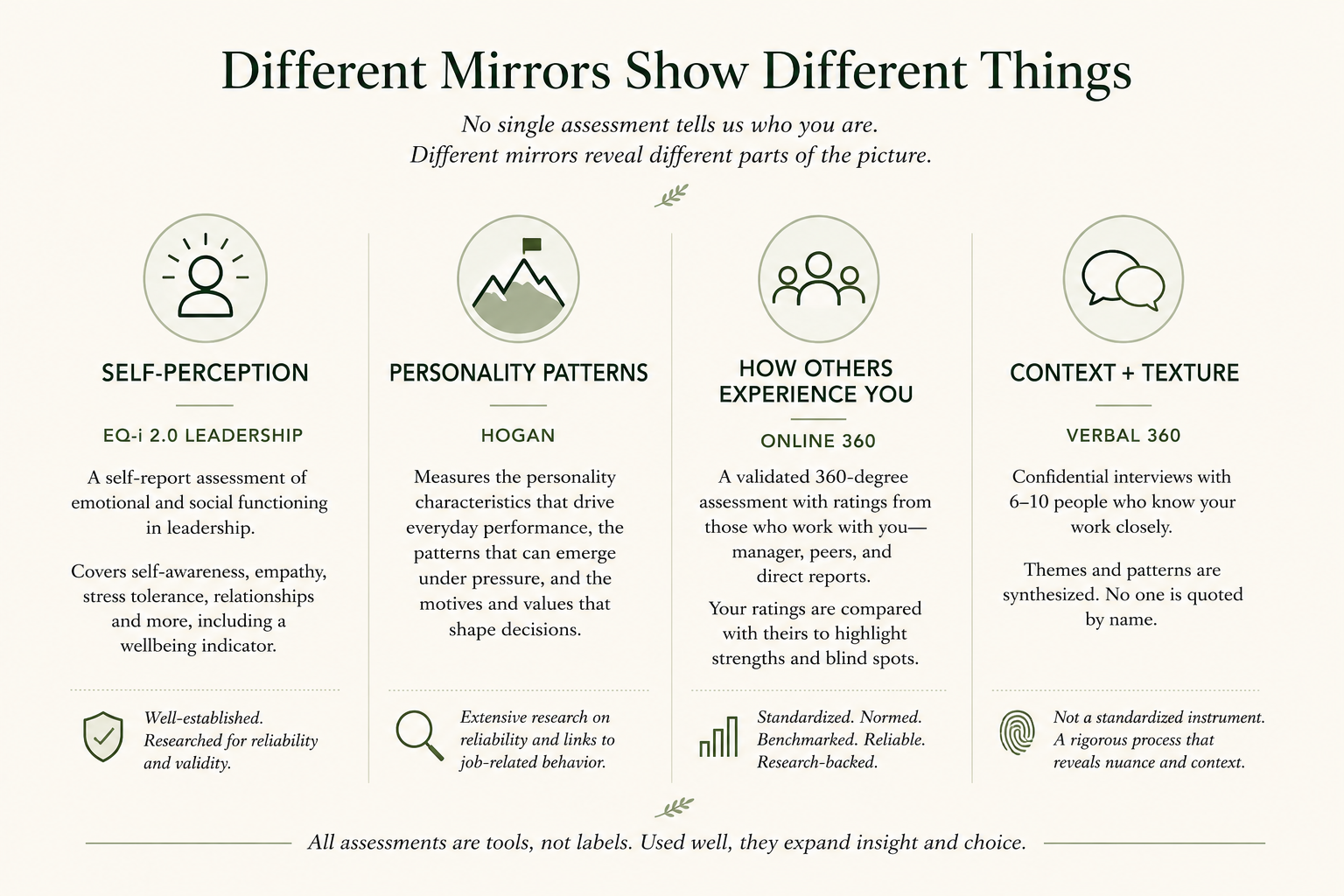
Different mirrors show different things
Depending on the leader and the goals, I may use several. Here is what each actually involves.
Hogan is a set of questionnaires you complete online in about an hour, examining dimensions of personality relevant to workplace behavior: the characteristics that support everyday performance, the patterns that tend to surface under pressure, and the underlying motives that shape what you find rewarding. Hogan publishes technical documentation of reliability and of the relationships between its measures and job-relevant behavior.
The pressure dimension matters here, because leadership is not only about what we do when conditions are good. The most consequential patterns appear when we are tired, scrutinized, or carrying more than usual. A leader whose intensity is an asset at full capacity may find the same intensity reads as impatience at the end of a hard week, which is exactly when someone decides not to raise the difficult thing.
EQ-i 2.0 Leadership is a shorter self-report questionnaire covering emotional and social functioning: emotional self-awareness, stress tolerance, empathy, impulse control, interpersonal relationships. It has documented reliability, validity, and normative data, and it carries a wellbeing indicator, which matters to me, because the effectiveness of a leader and the condition of the person leading are not separate questions.
Both are self-report, which is their limit. They tell us how you see yourself, benchmarked against a large comparison group. Neither tells us how you land.
For that, we ask other people. A 360 process gathers the perspectives of those who work with you, typically your manager, several peers, and several direct reports, chosen with you. Sometimes I use a validated instrument such as the EQ 360, which puts their ratings alongside your own so the gaps are visible. Sometimes a verbal 360 is more useful: I interview six to ten people confidentially, ask what it is like to work with you, what you should keep doing, and what gets in the way, then bring back themes rather than attributed comments. Nobody is quoted by name, and I say so at the start of every interview, which is usually when people begin telling the truth.
A verbal 360 is a rigorous process when done well. It is not a standardized psychometric instrument, and it should not be presented as one. What it offers instead is texture. Someone can say:
She is the person I want in the room during a crisis. Once she knows what she thinks, the room closes.
That sentence carries developmental information no score can fully capture.
Your results are yours. In a sponsored engagement, the organization does not receive your assessment reports unless you choose to share them.
We decide what success would look like
Now we can return to the original statement and make it observable. How early would problems reach her? What would someone do differently when they have something unfinished to raise? How would she respond in the first thirty seconds? What would her direct reports say had changed? What would show up in the number of surprises?
Those become the goals of the engagement. This follows professional standards: the ICF Core Competencies call for partnering with the client, and with relevant stakeholders, to establish the coaching plan and define measures of success.
Partnering is doing real work in that sentence. I do not decide what a good leader looks like and then turn you into that person. We decide together what you are trying to accomplish.
Then we coach
This is the part most people picture. We meet. You bring what is happening. Sometimes it is the strategic question you expected to discuss, sometimes the conversation you have been avoiding, and sometimes something that happened twenty minutes earlier, which is often the most useful material available.
My role is not primarily to supply answers. It is to help you see more than you currently see, challenge assumptions that may be constraining you, notice patterns across situations that look unrelated, and help turn insight into something you can actually do on Wednesday. The ICF competencies describe coaching as a partnership, emphasizing active listening, evoking awareness, and facilitating growth. The engagement stays client-led.
I bring experience, questions, assessments, frameworks, research, and tools, and I draw on the OLEL Method™ where it is useful. A framework serves the client. The client does not serve the framework.
The Method offers three movements for working with whatever arrives. Turn inward with care asks what is happening in you right now, and whether you can look at it without immediately defending or fixing it. See clearly with wisdom asks what is actually true here, what you are assuming, and how someone else might experience the same moment. Engage with courage asks what now needs to be done, and what you are willing to practice differently.
These are not steps completed in order. They are interacting dimensions of one practice. Then you leave the session.
Then Wednesday morning arrives
Someone comes to our leader with something unfinished. Half a problem, no recommendation. She sees the shape of it immediately and knows what should be done.
Her old pattern is already underway.
Then she notices.
She asks what they are seeing, and she stays quiet long enough for an answer.
Twenty seconds. Nothing dramatic happened. Someone who has practiced one pattern thousands of times just practiced a different one.
Perhaps it goes well. Perhaps three days later the pressure is higher and she closes a meeting down completely. Good. Now we have something else to learn from.
Practice, notice, reflect, adjust, practice again. The session is where much of the noticing and reflecting happens, and it is one part of a cycle that keeps running after you leave.

Keeping the work in one place
Coaching engagements tend to scatter. Commitments made in one session are half-remembered by the next, resources arrive by email and disappear into an inbox, and three months in nobody can say what has actually shifted.
I run engagements in CoachAccountable, a platform built for this. It gives the work a single home. Your goals sit in one place. Actions you commit to are recorded, along with whether they happened. Notes, practices, and resources stay where you can find them. If we are tracking something, such as how often a problem reaches you early, the record builds session by session rather than depending on memory.
You get your own login and can see everything in your file. The platform is not the coaching. Its job is to stay out of the way, so the continuity of the practice remains visible.
What changes when your organization is investing
Sometimes the person being coached is the person investing. Sometimes an organization sponsors the engagement. That adds someone to the system, and it does not turn coaching conversations into reports for your employer.
A sponsored engagement usually opens with a three-way meeting between the leader, the coach, and the manager or HR sponsor. What prompted the investment? What outcomes matter to the organization? What would people hope to see differently? Then the question that governs everything else: what remains confidential?
ICF ethics guidance calls for strict confidentiality, and for confidentiality arrangements to be clarified and agreed among all parties before the work begins.
In practice the line falls here. The sponsor learns the goals, because they agreed to them, and hears whether progress is being made against them. A midpoint check-in might say that the work is on track and that how information travels in her team remains the focus. The sponsor does not learn what she said about her manager, what her assessments showed, or what she is struggling with. Those boundaries are set in writing at the start, not improvised later when someone asks a pointed question in a hallway.
Where the confidentiality line falls
The most common question a leader asks before accepting employer-funded coaching. Select any item to see how it works in practice.
These boundaries are set in writing before the work begins, not improvised later when someone asks a pointed question in a hallway.
Why I usually suggest starting with six months
Could coaching produce an insight in a single conversation? Certainly. That is different from changing a deeply practiced pattern.
A leader who has spent fifteen years reaching conclusions quickly does not stop because an assessment revealed that she does it. She has to meet the pattern, practice another response, see what happens, fail, reflect, and practice again, until the new response is available when the stakes rise. That takes enough time for real situations to occur and enough repetitions to produce evidence.
I would not claim research proves six months is optimal. It does not, and the length should follow the challenge. Some engagements run a few months, others a full year. Six months is a practical horizon: long enough to observe patterns across changing conditions, practice repeatedly, and gather evidence about whether something is meaningfully different.
Then we look again
Near the end we return to the questions we asked at the start. What was supposed to change? What actually changed? What did not?
Depending on the goals we might repeat a 360, conduct follow-up interviews, or revisit selected measures. Evidence is not only a score. Perhaps problems now reach her weeks earlier. Perhaps two people who had gone quiet are contributing again. Perhaps the same pattern still appears and she catches it in minutes rather than days.
Together those tell us whether development has moved from something discussed to something she can do.
What six months can look like.
Six movements that keep returning to each other, rather than six stages completed in order.
Before anything is diagnosed. What is happening, what changed, who is affected, and why it matters now.
Hogan, EQ-i 2.0, and a 360, chosen to fit the challenge. Another way of looking, not a verdict.
Goals made observable, agreed together, with measures of success named before the work begins.
The center of it. Real situations, different responses, and what happens when the pressure rises.
Evidence gathered as we go: behavior, feedback, how time is spent, what has stopped happening.
What changed, what did not, and what the answer reveals about where the work goes next.
Not a linear process. A continuous cycle of awareness, practice, feedback, and adjustment.
The goal is not to need your coach in the room
Six months on, our leader is still herself. She still sees answers quickly, still holds high standards, still feels the pull to resolve things fast when something important is at risk. Removing those qualities was never the point.
What is different is that she recognizes when a strength is about to become a liability. She knows what happens in her under pressure. She understands more about how other people experience her. When someone arrives on Wednesday morning with half a problem, she has more than one response available.
Her coach is not in the room. That is the point.
Coaching gives us a dedicated place to build awareness, examine our leadership, receive feedback, and learn. Some of the most consequential work of an engagement happens right there, in the hour, when something becomes visible that had not been visible before. Leadership then happens everywhere else. In the meeting. In the pause before responding. In the decision you choose not to make for someone else. In the conversation you have been avoiding. At the kitchen table.
Those are the repetitions from which a way of leading is built.
Every moment is practice.
The first conversation
is already the work.
Every engagement begins the way this article describes, with listening. A first conversation looks at what is actually happening, what would need to change, and whether coaching is the right investment for it. Sometimes the answer is that it is not, and that is worth knowing before anyone invests anything.
OLEL works with senior leaders, executives, founders and entrepreneurs, creatives, and people carrying responsibility in institutions, organizations, and communities. Engagements are designed around what the work calls for, ranging from a few months to a full year.
See how an engagement is structured, what it includes, and whether it fits where you are.
A short, editable template for asking your organization to sponsor an engagement. Written to open a conversation about a business problem rather than to ask for a personal benefit.
Make a copy →A single page setting out what an engagement involves, how the return reaches a team and an organization, and what a sponsor gets in the way of structure and visibility. Written to be forwarded.
Read the one-pager →