
Most organizations can describe the leadership they want. What is missing is the bridge between here and there.
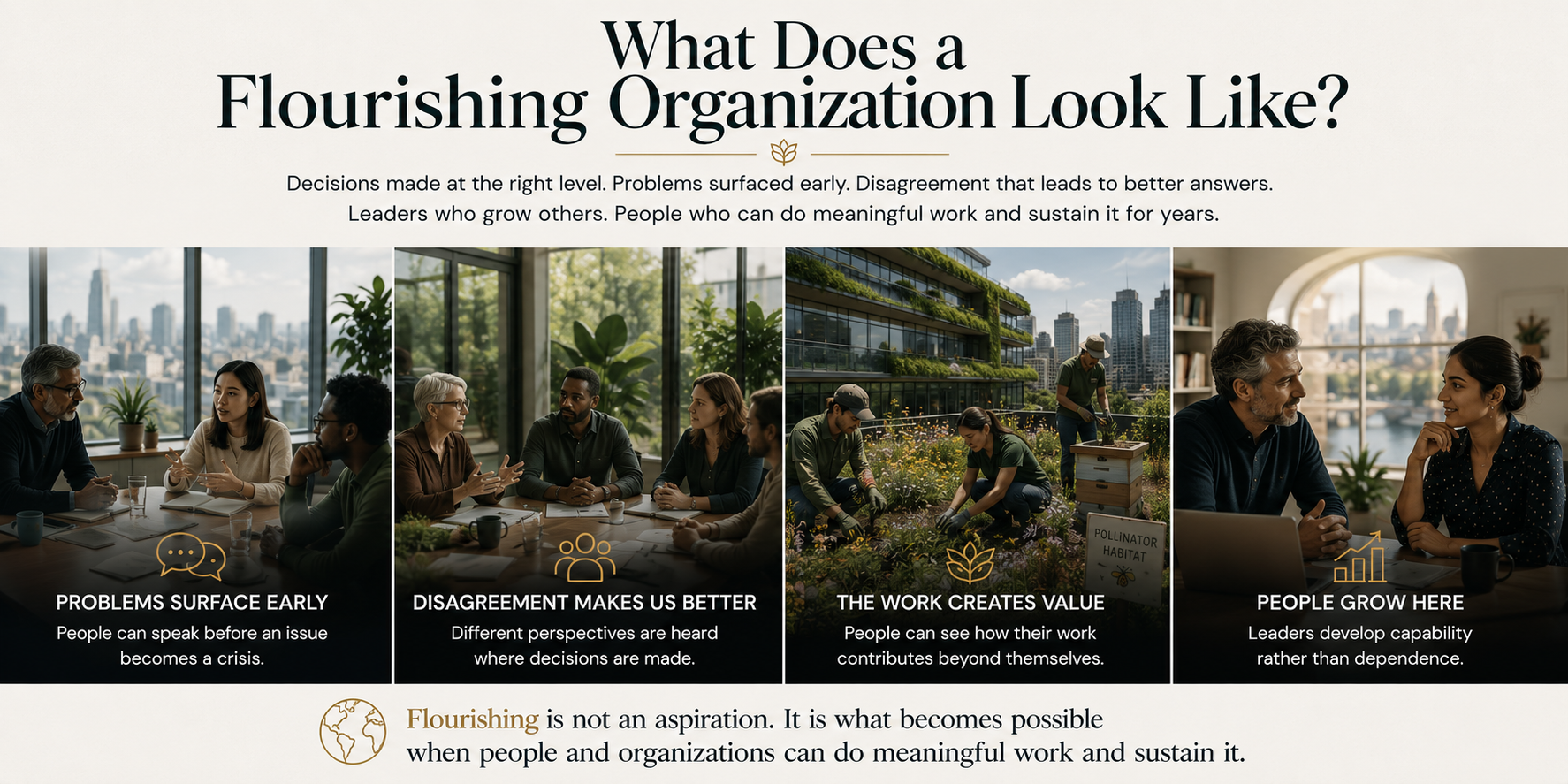
The destination is worth being specific about. An organization where decisions get made at the right level, problems surface early, disagreement happens in the room, and people can sustain the work for years.
Events cannot carry you there. A keynote or a workshop is a moment. Leadership is built from what gets repeated afterward, and that part usually goes undesigned.
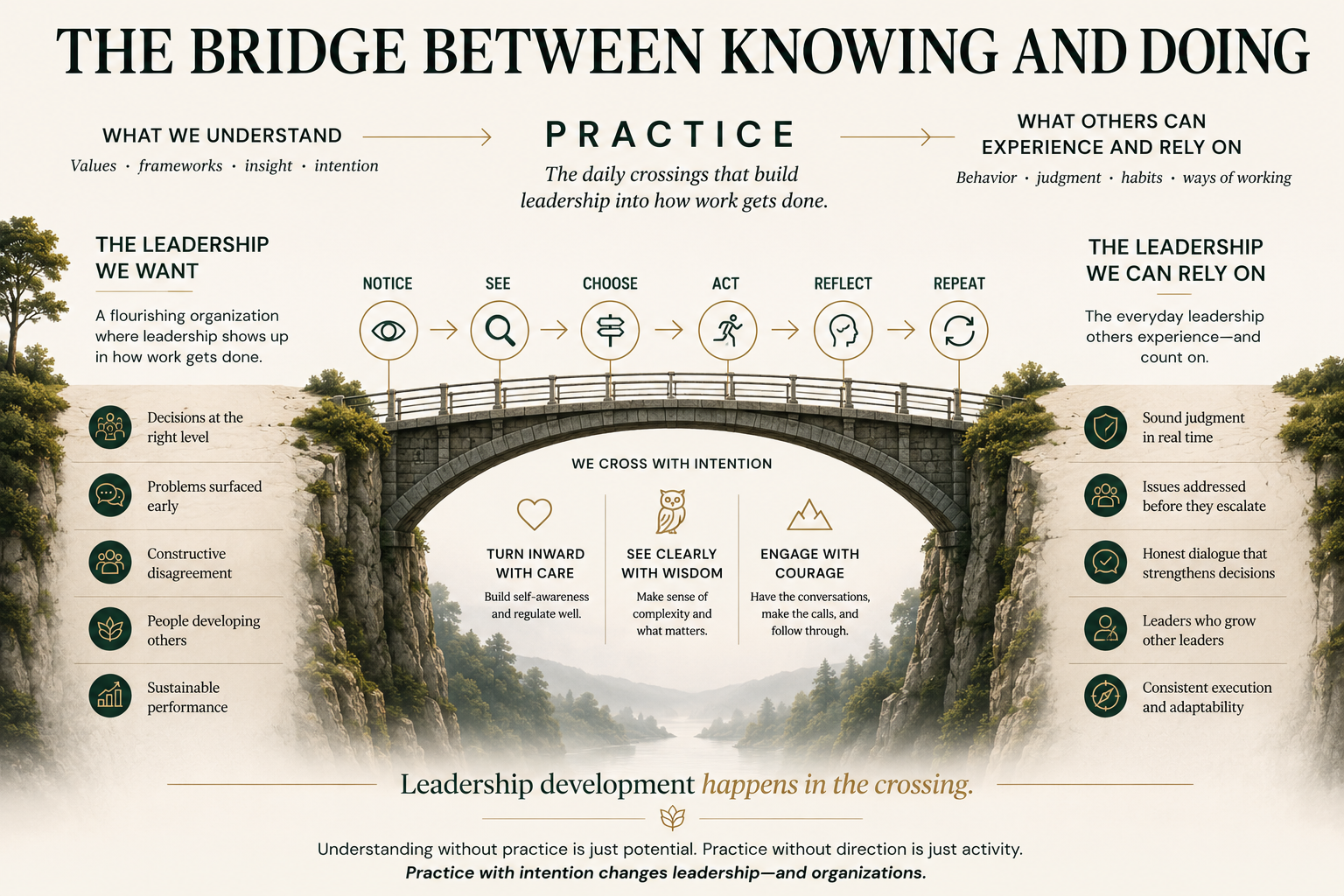
Practice is the bridge. Not as a discipline for its own sake, but as the only mechanism that turns a good idea into how an organization actually operates.
Leadership development has a reputation for not sticking, and organizations usually arrive with a format in mind. We need a leadership workshop. We are planning our annual offsite. Could you give a keynote?
Those are reasonable places to begin a conversation. They are not where the work should begin, because the format is the last decision, not the first.
The first is what you are trying to build.
What we are actually trying to build
It is worth being specific, because most descriptions of leadership development stop at the level of capability, and capability is not the point. The point is what becomes possible.
Picture an organization where decisions are made by the people closest to the work, and made at the speed the situation deserves. Where a problem surfaces while it is still small and cheap, because nobody is calculating whether raising it is safe. Where disagreement happens in the meeting rather than in the hallway afterward, and produces a better answer rather than a wound. Where a senior team can hold a hard conversation without it costing them three months of goodwill.
Picture leaders whose scope can grow with the business, so the organization is not perpetually hiring in for capability it could have built. Managers who want the job, and people underneath them who can imagine wanting it next. Strong performers who stay, because the work asks a great deal of them and gives something back.
Picture the whole of it running at a pace people can sustain for years rather than quarters. Not comfortable, not slow, sustainable. There is a version of high performance that uses people up and a version that does not, and the difference is largely a function of how the people at the top lead.
None of this is aspirational in the vague sense. Each element has been measured. Teams where people can raise problems without calculating the risk learn faster and perform better, which is the finding that made psychological safety a mainstream concern rather than a soft one. Business units in the top quartile of engagement outperform the bottom quartile on profitability, productivity, and quality, across a Gallup dataset of more than 180,000 units. Researchers at Oxford matched employee wellbeing against financial results in around 1,600 listed US companies and found it associated with profitability and firm value. And organizations do reach this condition: Gallup's best-practice organizations recorded manager engagement of 79 percent in 2025, roughly four times the global average, in every region and every industry.
That is a flourishing organization, and it is not a soft ambition. Flourishing is a defined construct with an instrument behind it, developed at Harvard's Human Flourishing Program across domains including health, meaning and purpose, character and virtue, and close relationships. It has been validated in employee populations, and it is being measured inside major employers, among them Levi Strauss, Owens Corning, and Aetna, in a five-year research collaboration. Anyone who files the word under wellness is a few years behind where the research has gone.
What flourishing describes, at the organizational level, is the condition in which an organization becomes genuinely capable of doing the thing it exists to do. Most organizations can recognize this picture. Many can describe it in their values. Very few can tell you how they intend to get there.
The gap is real, and it is getting wider
Organizations are investing heavily. The global market for corporate leadership training sat near $40 billion in 2025 and continues to climb, and estimates including internal budgets run several times higher.
The outcome moved the other way. Gallup's 2026 report put global employee engagement at 20 percent in 2025, the lowest since 2020, at an estimated cost of $10 trillion in lost productivity.
The revealing part is who is driving that. Engagement among people who manage nobody has stayed roughly flat. Manager engagement fell from 31 percent in 2022 to 22 percent in 2025, nine points, five of them in a single year. Managers were historically more engaged than the people they lead. That premium is nearly gone. The population every leadership program is aimed at is the one disengaging fastest.
Some of that is not a development problem, and an honest partner should say so. Managers have absorbed five years of restructuring, digital transformation, AI, hybrid logistics, and shrinking budgets. Organizational flattening has widened spans of control, and Gallup's research finds manager engagement falls as spans grow. If someone's team doubled and their support disappeared, coaching will not fix that. Development is the right answer for a capability gap and the wrong answer for a structural one, and expensive programs are sometimes bought precisely because the structural conversation is harder to have.
But underneath sits a simpler fact. Only 44 percent of managers have ever received any formal training. More than half the world's managers are running teams, handling conflict, developing people, and carrying change with no preparation at all. The capability gap is real. What is failing is the way we keep trying to close it.
One population collapsed. It took the average with it.
The overall decline is not a general decline. Employees who manage nobody held roughly steady. Managers fell nine points in three years, and five of those in a single year.
The event was not the problem. The event alone was.
What happens after the training moves the number roughly three times as far as the training itself.
Why the events do not carry across
Most leadership programs are well designed and well delivered. People leave genuinely changed in how they see something. Then Monday arrives, the calendar fills, a customer complains, the person who always dominates the meeting dominates the meeting, a decision is needed before lunch. And everyone does what they have practiced doing thousands of times.
That is not a failure of content. It is a category error.
We asked an event to do the work of a practice.
Every leader is already practicing, all day, whether anyone calls it that. Interrupting. Deferring. Rushing to consensus because disagreement is uncomfortable. Solving what someone else should be solving. These are repetitions, hundreds a week, and repetitions are how a way of leading gets built. A workshop offers perhaps six of them. The following month offers several hundred, none of which appear on anyone's design document.
The evidence lines up exactly here. Gallup found training alone moved the proportion of thriving managers from 28 percent to 34 percent, while training combined with someone actively supporting their development lifted it to 50 percent. The transfer research says the same in more technical language: the conditions people return to predict whether training reaches their work, and that matters more for leadership than for technical skills, because leadership is exercised in unpredictable situations rather than performed as a procedure.
None of this is inevitable. The best-practice organizations described earlier are not running more events than everyone else. They are doing something different with the time between them.
Practice is the bridge
This is the part the market largely does not sell. Inspiration is available everywhere. So are systems, frameworks, and competency models. What is scarce is the crossing between them: the thing that turns an idea a leader believes into behavior an organization can rely on.
That crossing is practice, and it is more concrete than the word suggests. The OLEL Method™ organizes it around three movements, each of which becomes something specific a leader does in ordinary conditions.
Turn inward with care is noticing what happens in you in the second before you respond. Catching the tightening in the chest when a decision is questioned, before the defense assembles. For a team, a short check at the start of a meeting about what people are actually walking in carrying.
See clearly with wisdom is asking what is true here, separately from what habit prefers. One question before any consequential decision: what am I assuming, and who would see this differently? For a team, naming out loud when it is converging too fast.
Engage with courage is acting while it is still uncomfortable. The conversation held this week rather than next quarter. The decision made rather than routed to a working group. The thing said in the room instead of the hallway.
None of these requires a new hour in anyone's week. They require the next meeting, which is already on the calendar. That is what makes them survivable, and it is why they compound. A leader who catches the impulse before responding fifty times over three months has become a different leader in a way no amount of understanding could achieve.
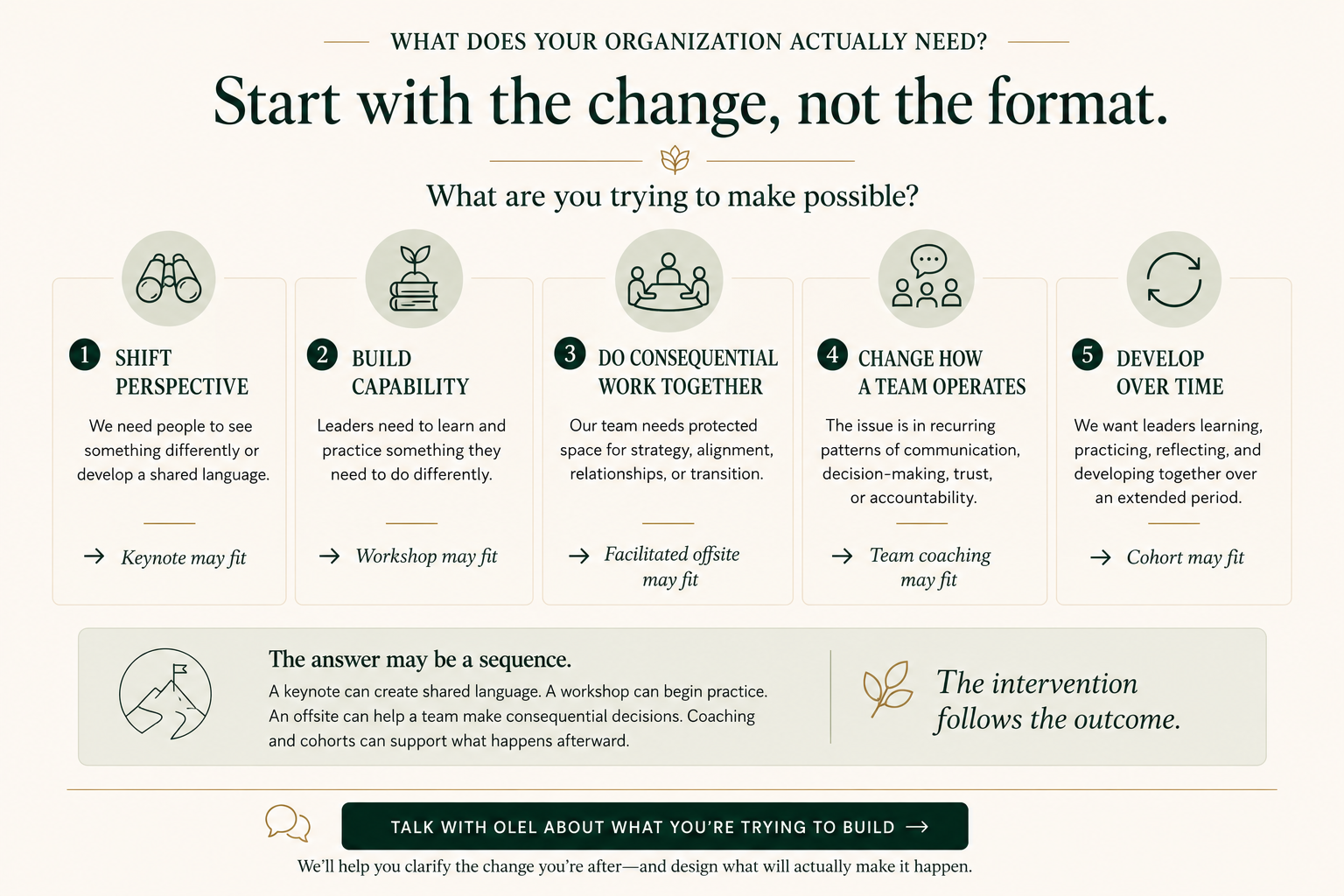
The formats still matter, because each starts a different kind of repetition. A keynote begins a perceptual one, giving a large group something they now notice. A workshop produces the first few repetitions of a new behavior under supervision. An offsite creates protected attention long enough for a team to reach agreements it could not reach in its normal rhythm. A cohort builds practice across months with peers who notice whether you did it. Team coaching works with a team as it leads, when the real decision arrives and someone takes over and information stops moving.
Often the answer is a sequence of them, connected. That is different from four unrelated leadership events in a year, hoping they accumulate into culture change.
Designing the crossing
So the design starts at the far side and works back. What does this organization need its leaders to be able to do that they cannot reliably do today? In which specific moments does that either happen or not happen? What practice fits inside those moments? And only then, which format starts it.
Sometimes the honest answer is that the workshop you asked for will not get you there, and something else will.
Then the part most providers leave out. Implementation support, because the weeks between sessions are where the work takes hold or evaporates, and they deserve structure: practices to run, prompts when attention drifts, peer groups that meet without a facilitator, managers who know what their people are working on. Measures agreed before we start, so we know what evidence would tell us something changed, and can say plainly if it did not. Gallup found that participants in manager coaching programs saw up to 22 percent higher engagement and their teams up to 18 percent higher, with effects still present nine to 18 months later. Duration is the part worth noticing. Most measurement of leadership development stops long before that.
Monday is the point
The difficult colleague. The overloaded calendar. The employee who tells you something you do not want to hear. The moment a team starts repeating the pattern it promised at the offsite it would stop repeating.
We do not develop leaders so they can become excellent participants in leadership programs. We develop them because their ordinary decisions shape whether an organization becomes the one described at the top of this page, or stays the one it is.
That organization is not built at the offsite. It is built in several hundred unremarkable moments a month, by people who have decided what they are practicing and have help to keep at it.
Every moment is practice. The question is what yours are building.
Sources
Engagement, manager engagement, and the economic cost
Gallup, State of the Global Workplace: 2026 Report. Findings from 263,810 respondents across more than 160 countries.
Training alone versus training with ongoing support
Gallup research on manager wellbeing, development, and the persistence of coaching effects, reported in the same series.
Measuring flourishing, including in workplaces
VanderWeele, T. J., "On the Promotion of Human Flourishing," PNAS (2017), and the Human Flourishing Program at Harvard with the SHINE Program at the Harvard T.H. Chan School of Public Health. Workplace validation in Węziak-Białowolska, D., McNeely, E., & VanderWeele, T. J., Cogent Psychology (2019).
Psychological safety and team performance
Edmondson, A. C., "Psychological Safety and Learning Behavior in Work Teams," Administrative Science Quarterly (1999), and Frazier et al., "Psychological Safety: A Meta-Analytic Review and Extension," Personnel Psychology (2017).
Engagement and business outcomes
Gallup, Q12 Meta-Analysis, 11th edition (2024).
Wellbeing and firm performance
De Neve, J-E., Kaats, M., & Ward, G., Workplace Wellbeing and Firm Performance, University of Oxford Wellbeing Research Centre Working Paper 2304.
Transfer of training
Blume, B. D., Ford, J. K., Baldwin, T. T., & Huang, J. L., "Transfer of Training: A Meta-Analytic Review," Journal of Management (2010).
Market size
Corporate leadership training market estimates from Fortune Business Insights and comparable analyses. Figures vary considerably by methodology, depending on whether internal budgets and staff time are counted.
