
The return on executive coaching is real, harder to measure, and more meaningful than a single number suggests.

Coaching should create value. A significant investment of money and attention should produce meaningful change, and we should be willing to look for evidence that it has.
The return is larger than revenue. Leadership shapes decisions, people, organizational capacity, whole sectors, and the life of the person doing the leading.
The measure should follow the challenge. Strong engagements name what needs to change before the work starts.
If you spend a five-figure sum on six months of executive coaching, it is reasonable to ask what you should get in return. I think you should ask.
Coaching has an uncomfortable relationship with measurement. Leadership is complex, behavior resists quantification, and organizational outcomes have many causes at once. So it becomes tempting to retreat into words like transformation and growth without ever asking what actually changed. That is not good enough. If coaching is a serious investment of money and time, there should be something important enough to work on and some way of recognizing whether the work is making a difference.
There is an equal and opposite problem. We can become so eager to prove that coaching works that we reduce its value to a single financial figure. Revenue rose. Costs fell. Someone calculated a percentage. Those things matter, and leadership creates consequences that do not fit in a spreadsheet.
A CEO stops being the bottleneck, and ten people begin making decisions they used to escalate. A leader learns to have difficult conversations earlier, and a problem that once consumed six months of organizational attention is handled in two weeks. A leader becomes less defensive, nothing appears on the income statement that afternoon, and six months later the people around them are challenging assumptions they had kept to themselves.
What is that worth? The return on a better leader is real. It is also more complicated than a number.
Start with what was supposed to change
This is where the conversation usually goes wrong. We ask about return at the end. I would rather begin there.
Suppose a leader says they need to delegate more. That is not yet a coaching outcome. Why does it matter here? Perhaps every significant decision routes through them, their team waits, strategic work gets deferred, strong people grow frustrated, and they work sixty hours a week doing work that belongs to four other people.
Now we have something we can examine. Six months later, perhaps decisions are being made where they belong. Direct reports describe greater ownership. Escalations fall. The laptop stays closed after dinner.
That is a richer picture of return than any percentage, and it was available from the beginning. The measure follows the challenge.
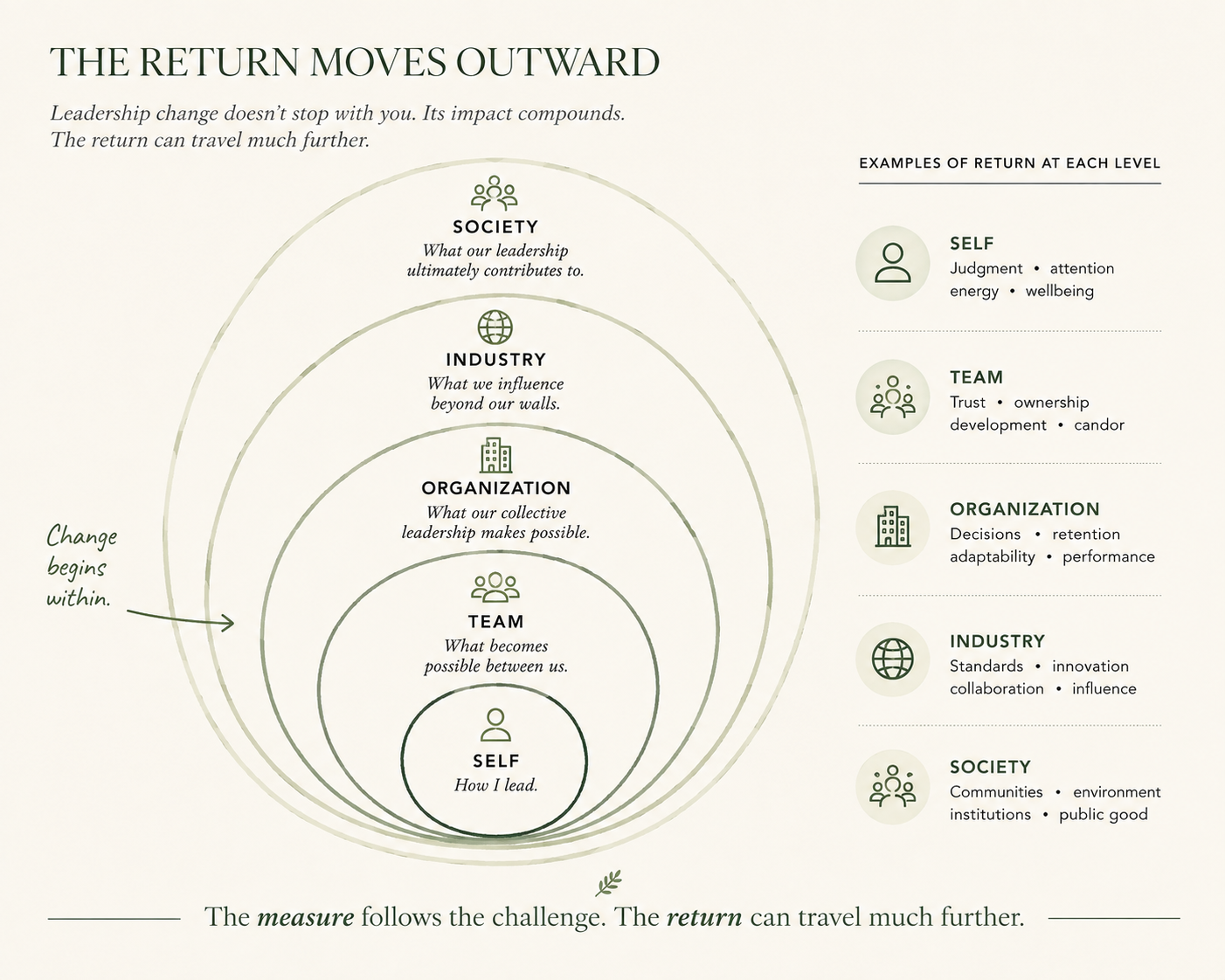
The return moves outward
In What Is Coaching For? I argued that the consequences of leadership travel outward through five levels. The same structure changes how we understand return.
Self. Better judgment. Sharper self-awareness. More deliberate use of attention. Greater capacity to stay regulated under pressure. Sustainable energy. Sleep. Relationships. Some of this is subjective, which does not make it trivial. A leader who produces exceptional results only while chronically depleted has built a fragile kind of performance. It works until it does not.
Team. Are direct reports developing? Can people disagree? Are difficult conversations happening sooner? Is the leader building capability or dependence? The scale here is easy to underestimate. In a survey of several thousand workers across ten countries, the Workforce Institute at UKG found people reporting that their manager affects their mental health about as much as their spouse or partner, and more than their doctor. That is self-reported perception, from an organization that sells workforce software, so discount it accordingly. Even discounted, it explains why one leader's development is worth this much attention.
Organization. Decision quality, retention, succession, adaptability, fewer bottlenecks, financial performance. Here the evidence is strongest. Gallup's engagement meta-analysis, built from more than three million responses, finds that business units in the top half on engagement roughly double their odds of success against a composite of financial, customer, retention, and quality measures. Researchers at Oxford's Wellbeing Research Centre matched wellbeing data from around 1,600 listed US companies against financial results and found wellbeing associated with profitability and firm value. In one study that comes closer to cause, tracking call center workers whose mood varied with weather and building layout, a one-point rise in reported happiness corresponded to roughly a twelve percent gain in productivity.
Institution. Beyond any single organization sits the sector it belongs to. Researchers modeling the cost of physician burnout in the United States estimated roughly $4.6 billion a year from burnout-related turnover and reduced clinical hours, and called the figure conservative, since it omits consequences like medical errors and the load shifted onto colleagues who stay. An entire sector is paying for conditions its leadership creates. Healthcare is simply the sector that measured it.
Society. The widest return is the slowest to appear. Whether urgency is temporary or permanent. Whether disagreement is welcomed or punished. Whether people finish the day with anything left over. These are decisions individual leaders make thousands of times, and Gallup's global estimates put the productivity cost of disengagement in the trillions. No coaching engagement can claim that as its return. It is still the direction the return points.
What the numbers can and cannot tell us
You will see claims that coaching returns five or seven times its cost. The most-cited traces to a study commissioned by the International Coaching Federation and conducted in 2008, reporting that most companies felt they had at least recouped their investment, with a median return near seven times.
I do not doubt those clients answered honestly. The method cannot carry the weight the number is asked to bear. The data is roughly seventeen years old and still circulates as current. The returns are self-reported by people who chose to buy coaching and had every reason to believe it worthwhile. There is no counterfactual, so we cannot know what would have happened without it.
The deeper problem is structural. Imagine that during a six-month engagement revenue rises, turnover falls, and a strategic initiative succeeds. How much of that was coaching? Twenty percent? Five? None? The market moved. People were hired. Strategy shifted. Hundreds of people contributed. Assigning a precise share to one developmental relationship requires assumptions no study can supply.
What the research does support is more modest and more useful. A meta-analysis restricted to randomized controlled trials, the most demanding standard the field has produced, found consistent positive effects of workplace coaching at a moderate effect size, while also reporting publication bias and larger effects for self-reported than observed outcomes. That honesty is what makes the finding believable.
Set that beside everything above and a chain emerges. Coaching produces real developmental change. Leaders shape the conditions around them. Those conditions are associated with organizational performance. Their absence carries costs measurable across whole sectors. Each link is evidenced. The chain end to end is not. No study takes you from this leader was coached to the organization gained this many dollars, and I am wary of anyone who claims otherwise.
What is the current pattern already costing?
Most of the cost of how a team is led never appears on a report. It sits in waiting, rework, senior time spent on the wrong things, and people who leave. Enter the figures for any leader and team, your own or one you are responsible for supporting, and see the order of magnitude.
The person who stopped offering ideas eighteen months ago, and now only answers questions.
The candidate who heard about this team from a friend and never applied.
The client complaint that reached the leader in March, having been known to three people since January.
The objection to the plan that was raised in the corridor afterward, by the one person who had seen it fail before.
The dinner someone sat through without being there, and the weekend that went the same way.
The sleep lost to a conversation that was never going to be resolved at three in the morning.
These are the largest costs on the page, and none of them will ever appear on one.
What this is, and what it is not. This is arithmetic on the figures entered, not a measurement. It shows the order of magnitude of a pattern, which is usually the useful part, and it should never be quoted to the nearest thousand.
It is also not an estimate of what coaching returns. No development engagement can claim to remove all of this, and anyone who tells you otherwise is selling something. What a number like this is good for is deciding whether a problem is worth serious attention, and what would have to change for that attention to be worthwhile.
Assumptions used: 46 working weeks a year, salary loaded at 1.3 for benefits and overhead, and replacement cost of a departing employee at half to one and a half times salary, which is the range most commonly cited. External senior hires are costed at roughly 22 percent of loaded salary for search, plus three months at half productivity while someone gets up to speed. Vacant senior seats are costed at the loaded monthly salary of the missing role. Time estimates are discounted by half at the low end, because people reliably overestimate recurring hours. Nothing you enter is saved or sent.
Flourishing raises the bar
There is a temptation to hear a word like flourishing and assume we have drifted into something softer. The opposite is true. Flourishing asks us to look at more consequences, not fewer, and it is measurable: researchers at Harvard's Human Flourishing Program have built an instrument assessing domains including health, meaning and purpose, character and virtue, and close relationships, validated for workplace use.
Consider what the wider frame catches. An executive raises productivity twenty percent by working fifteen more hours a week. That may hold for a while. It is not development. A CEO becomes faster and more decisive, results improve, and the leadership team grows quietly reluctant to disagree. We should want to know that. The reverse counts too. A leader cuts their workload, feels much better, and still avoids the difficult decisions their role requires. Wellbeing has improved. Leadership has not.
Flourishing is not comfort, and it is not maximizing every desirable variable at once. It means becoming more capable of producing good outcomes while staying accountable for how they are produced.
Some of the return happens at dinner
Leadership development does not stop when the workday does.
Imagine a leader who begins coaching because they cannot stop working. Attention fragmented. Email at dinner. Awake at three in the morning rehearsing tomorrow. Six months later their revenue may be unchanged, and they have learned to recognize the urgency that made every task feel immediate. They delegate differently. They sleep. They sit through a meal without reaching for the phone.
Is that return? I think it is, and not because executive coaching should become lifestyle coaching. Because the executive is a person, and if we develop someone's capacity to lead while the rest of their life becomes less livable, our definition of development is too narrow.
These domains are not in competition. Researchers publishing in the Academy of Management Journal tracked leaders and their teams daily across two working weeks, each group reporting separately. When leaders slept poorly, their teams reported more hostile behavior from them the next day, and those units showed lower engagement that same day.
The leader's night became the team's morning.
A leader's capacity to be present at dinner and their capacity to be present in a difficult meeting may not be separate skills. Both involve attention. Both involve noticing an impulse without automatically obeying it. Both are practice.

Which brings us back to ordinary moments
Return cannot only be assessed at the end of an engagement. Change is happening, or failing to happen, continuously.
The coaching conversation may reveal that you solve too many problems for your team. The return is created Tuesday morning, when someone brings you a problem and you do not solve it. The assessment may reveal that you become controlling under stress. The return is created when the pressure rises and you notice the pattern before you act from it.
These moments look too small to measure. Repeated across months and years, they become the whole thing. Every moment is practice, and every practice produces something.
So is it worth it?
Sometimes.
An engagement is not worth its price because it contains twelve sessions and an assessment. The hours are almost beside the point. The value depends on what is at stake. If the challenge is vague and nothing consequential needs to change, the return will be modest. If a leader is navigating a significant transition, creating an expensive bottleneck, losing strong people, carrying a pattern that touches hundreds of employees, or succeeding in a way that is becoming personally unsustainable, the arithmetic looks entirely different.
So I would not ask what coaching returns on average. I would ask what would need to change for this investment to be worthwhile. Then define it. Practice. Measure what can reasonably be measured, and listen for what cannot.
The return on leadership development should be larger than a better-performing leader.
It should be visible in what becomes possible around them.
What would make coaching worth the investment?
Start with the challenge, not the price. Nothing here is stored or sent anywhere.
The first conversation
is already the work.
Every engagement begins the way this article describes, with listening. A first conversation looks at what is actually happening, what would need to change, and whether coaching is the right investment for it. Sometimes the answer is that it is not, and that is worth knowing before anyone invests anything.
OLEL works with senior leaders, executives, founders and entrepreneurs, creatives, and people carrying responsibility in institutions, organizations, and communities. Engagements are designed around what the work calls for, ranging from a few months to a full year.
See how an engagement is structured, what it includes, and whether it fits where you are.
A short, editable template for asking your organization to sponsor an engagement. Written to open a conversation about a business problem rather than to ask for a personal benefit.
Make a copy →A single page setting out what an engagement involves, how the return reaches a team and an organization, and what a sponsor gets in the way of structure and visibility. Written to be forwarded.
Read the one-pager →Sources
Managers and mental health
The Workforce Institute at UKG, Mental Health at Work: Managers and Money (2023). Survey of 3,400 people across ten countries.
Engagement and business outcomes
Gallup, Q12 Meta-Analysis, 11th edition (2024). More than 3.3 million responses across 183,806 business units in 347 organizations.
Wellbeing and firm performance
De Neve, J-E., Kaats, M., & Ward, G., Workplace Wellbeing and Firm Performance. University of Oxford Wellbeing Research Centre Working Paper 2304 (2023, revised 2024).
Happiness and productivity
Bellet, C. S., De Neve, J-E., & Ward, G., "Does Employee Happiness Have an Impact on Productivity?" Management Science 70(3), 1656–1679 (2024).
The cost of burnout in a sector
Han, S., Shanafelt, T. D., Sinsky, C. A., et al., "Estimating the Attributable Cost of Physician Burnout in the United States," Annals of Internal Medicine (2019).
The global cost of disengagement
Gallup, State of the Global Workplace (2024).
The frequently cited return figure
International Coaching Federation, Global Coaching Client Study, conducted by PricewaterhouseCoopers and Association Resource Centre (2008, published 2009).
Coaching effectiveness
"What Can We Know about the Effectiveness of Coaching? A Meta-Analysis Based Only on Randomized Controlled Trials," Academy of Management Learning & Education (2023). Thirty-seven randomized controlled trials, 1994–2021.
Measuring flourishing
VanderWeele, T. J., "On the Promotion of Human Flourishing," PNAS (2017), and the Human Flourishing Program at Harvard. Workplace validation in Węziak-Białowolska, D., McNeely, E., & VanderWeele, T. J., Cogent Psychology 6 (2019).
Leader sleep and team engagement
Barnes, C. M., Lucianetti, L., Bhave, D. P., & Christian, M. S., "You Wouldn't Like Me When I'm Sleepy: Leaders' Sleep, Daily Abusive Supervision, and Work Unit Engagement," Academy of Management Journal 58(5), 1419–1437 (2015).
